

trends > therapy
crying for help on the FYP

Trends are teachers.
When the collective latches onto something, it tells us a story about how they’re feeling and how they want to be perceived.
They’re also a soft entry point for political participation, an opportunity for creators to contribute to collective conversation with a bat signal that says, “I feel it too.”
Right now, everyone’s freaking the fuck out about the future, frantically editing videos that remind us of our resiliency, affirm our independence, comfort us against the unknown, and define us beyond the roles we’ve been performing.
The security we’ve all been craving is right there on our FYP.
Me? Turn something as fun and innocent as a social media trend into an existential discussion about the inner workings of our current society? Never.
We were standing at the crosswalk under the 100 degree sun on Saturday when I heard myself bitching about how out of hand The Butterfly Effect trend has gotten. I’m pretty sure my exact words were, “Oh? something happened and then something happened and then something happened? So you mean, like, life?”
But that’s exactly the point. The Butterfly Effect isn’t some unique phenomenon that only the select few experience — it’s just a pretty way to describe the random sequence of choices that add up to the lives we lead. It highlights both our complete control and our complete lack of it, suggesting that our decisions catalyze everything we experience but also, we have no fucking idea what that’s going to mean when we decide them.
Another trend that hits the same note is “PLAN A VS. PLAN B” which takes on two tones, either “there was no Plan B, I bet on myself and I made it!” or “I’m so glad Plan A didn’t work out because Plan B is so much better.”
Given the political and economic climate, of course the internet is obsessed with this right now.
While we’re dressing it up in “I’m so glad I went to that random beach party in Madrid in 2017!” or ”my original dream was becoming a teacher but I’m so glad I’m a beauty influencer instead!” what we’re really saying is, “things are always working out in my favour even when I can’t predict or control them.”
Each of these videos is a reassurance that no matter what happens, we’re on our way to something good.
Life is fucking random. Thank god.


If we’re not celebrating the unpredictable future, we’re coping with it by living in the present.
The “This is the Whole Point” trend is all about reconnecting with our why, identifying that whatever duress we’re under at the moment, we’re doing it for a reason.
I’ve seen countless angles on this one, some wholesome and family-friendly, some calling attention to the environment and the beauty of the natural world, many about connection and life offline and community. It’s unsurprising that these are the salves we’re reaching for: the glimmers that exist outside of our phones and independent of the news cycle.
So much beauty can still be found, right in front of us.


This public display of purpose relates to another series of algorithmic declarations, desiring to be both understood and undefined. Aching to be seen whole on the internet isn’t new — it’s been ramping up increasingly for the last six months — but the way folks have been latching onto it lately is much more overt.
“Facts That Don’t Match My Appearance” has been making it’s rounds, and while I think there’s an even deeper layer to this (the judgement and expectations we assign to people based on the way they present) at minimum, it’s a chance to evaluate how much of ourselves is actually being witnessed within the one-dimensionality of the online world, reminding our communities that they only know a fraction of us.
The trend I’ve lovingly dubbed “All My Names” (because ironically, I’m not sure it has one?) offers us space to show all of the titles we hold — in partnership, friendship, at work — as well as the chance to nod back to how far we’ve come, how much we’ve changed, how we’re always evolving, minute-to-minute, shapeshifting depending what space we’re standing in.
Is this a good time to tell you that my parents call me Xanther Panther?
Baristas call me Nancy, though.
In iterations of social media past, trends have served as blueprints: something we can mimic to feel a part of the zeitgeist. Now, they’re a call towards participation — a glimpse into the conversation, and an invitation to contribute to it.
When you see a trend come across your desk, I challenge you to examine before you emulate.
Adapt it to suit your industry, massage it to make sense for your message, remix it to offer a fresh perspective. The most engaging interpretations of trends are the ones that create a new context for them, all together.
𐄂𐄂
FYI:
All of my self-paced online leadership programs + resources — including my Leisure Ethic Notion Template — are available for 34% off using code ERA34 right here ‘til April 23rd (and a bunch of ‘em are retiring this month!).
IMAGE LINKS:
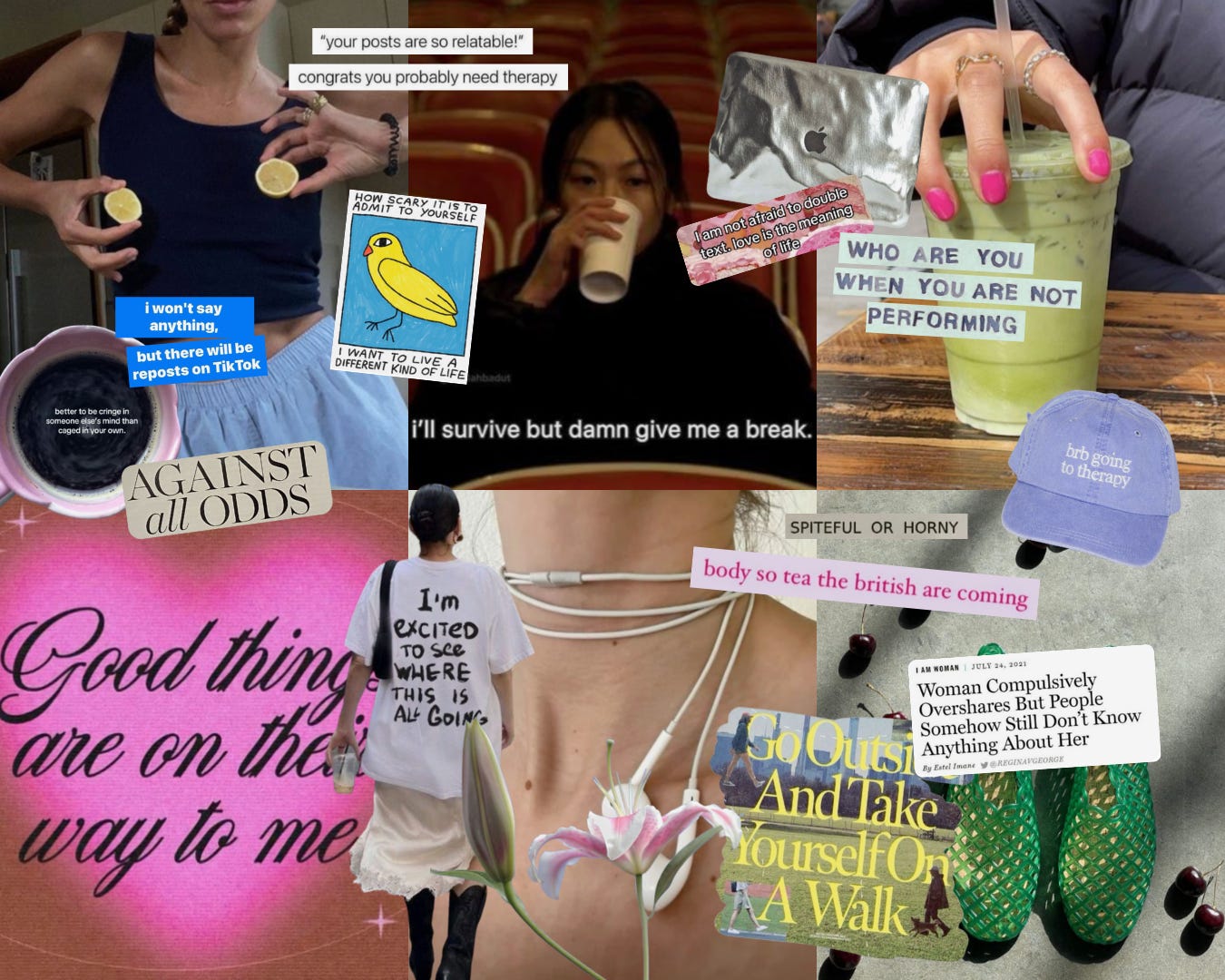
All collage imagery can be found on Pinterest here.
ICYMI:
financial transparency and the neutral truth

Where money meets online leadership, I’ve got THEORIES.


